
Quick Answer
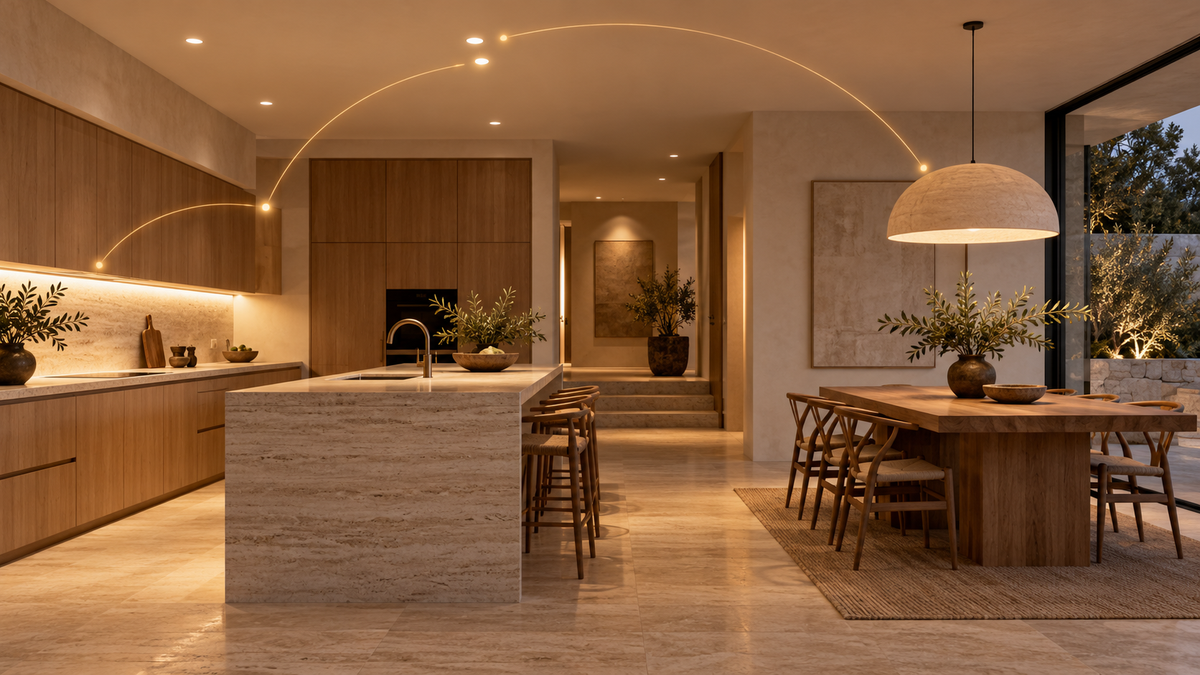
Casambi is a lighting-control platform that connects compatible lighting devices through a wireless mesh network. It lets users control lighting through the Casambi app and suitable control devices. A Casambi installation still needs correctly specified lights, drivers and electrical wiring; the wireless network carries control information. The functions available depend on the selected hardware and how the system is configured. Casambi system overview
What problem does Casambi solve?
A well-designed room often has several lighting layers: ceiling lights for general illumination, task lighting for work, and accent lighting for artwork or architectural details. The challenge is making those layers easy to use together.
Think about a kitchen and dining area. Preparing food, hosting dinner and cleaning up call for different lighting arrangements. A useful project brief describes those activities before it lists controllers. Otherwise, a technically capable installation can still leave people searching for the right button.
Casambi is one way to coordinate compatible lighting devices. It should be evaluated as part of the lighting design, alongside the luminaires, drivers, controls and installation conditions. The important question is what occupants need the lighting to do.
How does the wireless network work?
Bluetooth Low Energy provides communication between a mobile device or control device and the Casambi network. Within the lighting installation, Casambi uses its own mesh protocol for device-to-device communication. It is therefore important to specify actual Casambi-compatible equipment rather than assume any Bluetooth lighting product will join it. Casambi Mesh
For a project brief, separate two paths: the electrical path supplies the lighting load; the control path communicates the requested behaviour. A wireless control link does not remove the need to design the electrical installation.
When reviewing a layout, mark proposed control-device locations as carefully as luminaire positions. Keep access for maintenance in mind. A concealed component that is difficult to reach may complicate future service, even if its location looks tidy on a drawing.
What can a lighting scene do?
A basic Casambi scene includes selected luminaires and their adjusted settings. Different scenes can use different combinations and light levels. The official scene guide also notes that lights intended to remain off should be included and set to zero. Creating a basic scene
As a design example, a dining scene might combine gentle ceiling light with stronger illumination over the table. A cleaning scene might use a brighter general-lighting arrangement. These are proposed uses, not claims about a particular installed project.
Write a short scene schedule during design. Give each scene a clear name, identify the areas it affects, and describe its intended result. Avoid names such as “Scene 1” if staff or guests will use the system. Test the result in the finished room rather than judging it only from numeric dimming values.
Which devices belong in a Casambi project?
Casambi's ecosystem directory includes luminaires, control modules, switches, sensors and other device categories. Use it to investigate specific products, then check their documentation and intended application. Casambi ecosystem
A useful equipment schedule distinguishes the purpose of each component:
| Component role | Question to answer before specification |
|---|---|
| Luminaire or LED load | What electrical supply and control method does it require? |
| Driver or power supply | Does it suit the load and proposed dimming arrangement? |
| Control device | What does its output control, and under which limits? |
| User interface | How will occupants operate the lighting day to day? |
| Sensor, if required | Which area and behaviour should it respond to? |
| Integration equipment, if required | Which other system must communicate with the lighting? |
Treat this as a coordination checklist, not a mandatory shopping list. Some functions may already be integrated into a selected luminaire or driver.
Does Casambi need Wi-Fi or the internet?
Ordinary local Casambi network operation does not require an internet connection. Remote access and cloud-related functions are separate requirements and may need suitable gateway equipment and connectivity. Casambi system overview
Define “remote” carefully when talking to a supplier. Control from elsewhere in the room and control from another city are different requirements. Put the intended use in writing so the proposed system addresses the right problem.
For example, a homeowner may need a wall control by the entrance and app access while at home. A facilities team may also want off-site access. Those briefs should not be treated as identical. List the required users, locations and access arrangements before equipment is selected.
Can existing lighting be used?
Start by identifying the existing luminaire, driver and dimming method. Then ask whether there is a suitable control arrangement for that exact equipment. Compatibility has both a communication side and an electrical side.
For LED strips, LBD Lighting lists the PWM2 Pro as a two-channel Casambi-enabled dimmer for constant-voltage loads, installed between a 12–24 VDC supply and the load. The PWM5 Pro is a five-channel constant-voltage PWM device. These examples should not be treated as universal replacements for every driver or dimmer.
Before requesting a retrofit proposal, gather photographs of accessible equipment labels, model numbers, existing wiring documentation and the desired lighting behaviour. Have the installer resolve unidentified equipment before ordering control components.
For a more detailed selection process, read How to Choose a Casambi Controller. If your shortlist is specifically for LED-strip control, the PWM2 Pro vs PWM5 Pro comparison addresses those two products.
Where is Casambi worth considering?
Consider it where coordinated lighting behaviour could make the space easier to use. A multifunctional living area is one example: work, relaxation and entertaining may call for different arrangements. Casambi's residential guidance discusses adaptable lighting for such spaces. Residential design guide
For hospitality or retail, begin with the operational brief: who changes lighting, at what times, and for which activities? A restaurant manager needs understandable controls; a display designer may need a clear method for updating a lighting arrangement when the merchandise changes. These are design considerations to discuss, rather than automatic outcomes of buying wireless hardware.
Review practical success criteria. Can a new staff member find the normal operating setting? Is the cleaning arrangement obvious? Can the owner identify who holds administration access? Those questions make a proposal more useful than a list of features alone.
What limitations should be planned for?
Wireless control needs a realistic assessment of the installation. Casambi notes that materials and obstructions affect radio performance; metal enclosures can influence communication. Do not apply an advertised open-space range as a guaranteed result inside a finished building. Casambi system overview
Build a project review around four practical checks:
- Equipment: Record exact models and the documents used to select them.
- Operation: Confirm which controls occupants actually need.
- Installation: Review access, placement and the finished building conditions.
- Handover: Agree who receives the documentation and maintains the system.
A sample installation can be useful where existing fixtures or construction conditions are uncertain. Define what the sample needs to demonstrate, such as the expected dimming result and reliable operation from the intended control position.
What should you send to LBD Lighting?
Send a concise brief that includes the room use, lighting schedule, available equipment information and desired controls. Identify whether the project is a new installation or a retrofit. Include remote-access requirements separately from local operation.
A simple brief might read: “We are renovating an open-plan kitchen and dining area. We want separate control of task lighting, general lighting and an evening arrangement. Please review the attached strip and driver information and identify any missing details.”
Contact LED BY DESIGN with that information. A clearer brief supports a more useful product discussion and reduces assumptions during specification.
Key Takeaways
- Begin with how people will use the space, then define the lighting-control requirements.
- Casambi controls compatible equipment; electrical suitability still needs checking.
- Separate local operation from off-site access in the project brief.
- Give scenes meaningful names and test them in the completed space.
- Keep equipment records, access arrangements and handover information together.
FAQs
Is Casambi the same as a light fitting?
No. Casambi is a control platform; a luminaire is the equipment that produces the light. A selected luminaire may incorporate compatible control technology, or a project may use separate components.
Can I use an ordinary Bluetooth light with Casambi?
Do not assume so. Check for documented Casambi compatibility for the exact product. “Bluetooth” alone is insufficient information for a specification.
Do I need a phone for every lighting adjustment?
Define the daily operating method when specifying the project. Investigate suitable switches or other interfaces in the ecosystem rather than assuming occupants must use an app for every action. Check the chosen interface's functions before ordering.
Can I reuse the lights I already have?
Possibly, but the existing load, driver and control method need investigation. Provide exact model details to the installer or supplier; a Casambi label on a proposed device does not settle electrical compatibility.
Can a scene include lights that stay off?
Yes. Casambi's basic-scene guidance describes including those luminaires and setting their dimmed level to zero. Review the resulting scene in the actual room.
Is Casambi suitable for a home renovation?
It is worth assessing when the brief calls for coordinated lighting control. Suitability depends on the existing equipment, installation conditions and required operation. Compare proposals against those requirements.
What should I check before buying a controller?
Identify the load type, required supply, control interface, channel needs and electrical limits. Use the product documentation and the installer’s design to confirm suitability before purchase.
0 comments